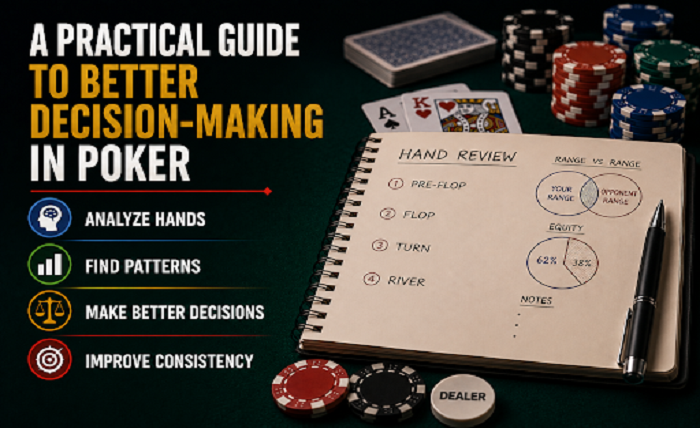
Poker hand analysis is one of the most effective ways to improve your game because it allows you to look beyond individual results and understand the quality of your decisions. Winning a hand does not automatically mean that you played it correctly, just as losing a pot does not necessarily mean that you made a mistake.
Strong poker players regularly review their hands, identify recurring patterns, compare their decisions with theoretically sound strategies, and use this information to improve future play. Instead of relying on memory or intuition alone, they build a structured process for understanding what happened in each important situation.
Why Analyzing Poker Hands Matters
Poker is a decision-making game played under conditions of incomplete information. You rarely know your opponent’s exact cards, so every decision is based on ranges, probabilities, position, board texture, betting patterns, and available information.
This makes hand review particularly valuable. During a session, decisions often have to be made within seconds. There is little time to consider every possible line. When reviewing a hand afterward, however, you can slow down and examine the situation objectively.
A good review can answer several important questions:
- Was the preflop decision reasonable?
- Did the bet size make sense?
- Was the range construction appropriate?
- Did the board favor my range or my opponent’s range?
- Should I have bet, checked, called, raised, or folded?
- Did my decision change appropriately as new information appeared?
- Was my river decision based on the opponent’s likely range or simply on the strength of my own hand?
These questions help transform individual hands into useful lessons.
Start With the Preflop Decision
Many postflop mistakes actually begin before the flop. For this reason, every serious hand review should start with the preflop action.
First, identify the positions of all players involved. Position has a major impact on opening ranges, calling ranges, 3-betting strategies, and postflop decision-making.
For example, a hand that is perfectly reasonable to open from the button may be too weak to open from an early position. Similarly, defending the big blind against a late-position open can involve a much wider range than defending against an early-position raise.
You should also consider the effective stack size. A decision with 30 big blinds can be completely different from the same decision with 150 big blinds.
Next, examine the action itself. Ask whether your raise, call, 3-bet, or fold fits the range you are supposed to represent.
Avoid reviewing the hand only by asking, “Did I win?” Instead ask, “Was this decision profitable given the information available at the time?”
That distinction is fundamental to long-term improvement.
Analyze the Flop as a Range, Not as a Single Hand
Once you have established the preflop ranges, move to the flop.
One of the most common mistakes among developing players is focusing too heavily on their own cards. Effective analysis requires thinking about the entire range of hands that each player can reasonably have.
Consider factors such as:
- Board texture
- Range advantage
- Nut advantage
- Position
- Stack-to-pot ratio
- Previous betting action
- Possible draws
- Value hands
- Bluffing candidates
For example, on a dry and disconnected board, the preflop aggressor may have opportunities to use a small continuation bet with a relatively wide range. On a highly connected board, the optimal strategy can be very different because the defending player’s range may interact more strongly with the board.
The key is to avoid thinking in absolute terms. Having a strong hand does not automatically mean you should bet, and having a weak hand does not automatically mean you should check.
The correct action depends on the interaction between your hand, your range, your opponent’s range, and the board.
Evaluate Bet Sizes Carefully
Bet sizing is another important part of hand review.
When analyzing a bet, do not simply ask whether the bet was “too big” or “too small.” Ask what the sizing is trying to accomplish.
A small bet can be used to apply pressure to a wide range while risking relatively little. A larger bet may be designed to extract value from strong hands, deny equity, or put difficult decisions on an opponent’s marginal holdings.
You should also consider whether your sizing makes sense for your entire range.
If you use a large bet only when you have strong hands, experienced opponents can potentially identify this pattern. Good strategies generally maintain enough balance that your betting actions are not immediately predictable.
Look at the Turn as a New Decision Point
The turn should not simply be treated as another opportunity to continue the strategy you started on the flop.
The new card can dramatically change the relative strength of both ranges.
Ask:
- Did the turn improve my range?
- Did it improve my opponent’s range?
- Did it create additional draws?
- Did it change which hands should bet for value?
- Did it create better bluffing opportunities?
- Should my betting frequency change?
A common leak is automatically firing a second barrel without considering how the turn card changes the situation.
For example, a turn card that completes a draw or significantly improves the defender’s range may require a much more cautious strategy. Conversely, a favorable turn card can create excellent opportunities to continue applying pressure.
River Analysis Requires the Most Discipline
River decisions are often the most difficult because there are no future cards to provide additional information.
At this point, your decision should be based heavily on range construction and combinations.
If facing a river bet, consider:
- Which value hands can your opponent have?
- Which missed draws can they bluff?
- Which weaker hands would they actually bet?
- How many combinations of each hand remain?
- Does the opponent’s line logically represent the hand they are claiming to have?
This is where many players make emotional decisions. They may think, “I have a top pair, so I cannot fold,” or “The board is scary, so I have to fold.”
A better approach is to ask whether your hand performs well against the opponent’s betting range.
This shift from absolute hand strength to relative range strength is one of the most important improvements a player can make.
Use a Structured Review Process
A consistent review system makes analysis much more useful.
Start by marking hands during your session. You do not need to review every hand immediately. Focus on situations that were difficult, unusual, expensive, or confusing.
After the session, divide the review into several stages.
1. Reconstruct the Action
Review the complete action from preflop to river.
Do not skip seemingly unimportant decisions. A small preflop mistake can create a much more difficult postflop situation.
2. Identify Your Initial Range
Determine which hands you should have at each stage.
This gives you a framework for evaluating whether your actual hand belongs in a particular betting or checking range.
3. Estimate the Opponent’s Range
Do not assign your opponent one specific hand too early.
Instead, build a range based on their position, preflop action, tendencies, and postflop decisions.
4. Compare Alternative Lines
Consider at least two or three possible actions.
For example:
- Bet vs. check
- Call vs. raise
- Fold vs. call
- Small bet vs. large bet
Then compare the advantages and disadvantages of each option.
5. Find the Actual Leak
The goal is not simply to determine whether one particular action was wrong.
Look for recurring mistakes.
Maybe you are calling too many river bets. Perhaps you are not defending enough against small flop bets. Maybe your turn aggression is too high, or your river betting range is too narrow.
These patterns are far more valuable than isolated mistakes.
Use Database Analysis to Find Patterns
Individual hand reviews are useful, but database analysis can reveal patterns that are almost impossible to recognize from a small number of hands.
A poker database can show how frequently you open from different positions, how often you defend the big blind, how frequently you continuation-bet, how often you barrel the turn, and how your river decisions perform across different situations.
This is where a service such as baseanalise.com can become useful for players who want to move beyond manually reviewing individual hands.
Instead of looking at one memorable pot, database analysis allows you to examine thousands or even millions of hands and identify statistically significant tendencies.
For example, you might discover that your overall flop strategy looks reasonable, but your turn aggression drops dramatically in specific situations. Or you may find that your river calls are profitable against some player pools but consistently losing against others.
The larger the sample, the easier it becomes to distinguish a genuine strategic pattern from normal short-term variance.
How Poker Analysis Helps You Find Recurring Leaks
Poker analysis becomes especially valuable when you stop looking at individual hands in isolation and start comparing similar situations across a larger sample.
Instead of asking why one particular hand went wrong, you can investigate whether the same decision appears repeatedly. Perhaps you are folding too often against flop continuation bets, defending too aggressively from the blinds, or failing to apply enough pressure on later streets.
This type of analysis helps connect individual hands with broader strategic tendencies.
For example, imagine that a player reviews five difficult river spots and initially believes that all five were unrelated. A deeper review may reveal that the player consistently gives opponents too much credit for value hands. The problem is therefore not one bad fold or call, but a recurring range-assessment issue.
Once the pattern has been identified, the player can study that specific situation and then monitor future results.
Combine Theory With Real-World Data
The strongest approach is not to choose between theoretical analysis and database analysis. Use both.
Theory can tell you what a strong baseline strategy should look like. Your database can tell you how your actual strategy differs from that baseline.
This creates a simple improvement cycle:
Theory → Database → Identify Leak → Review Hands → Make Adjustment → Measure Results
For example, suppose your theoretical strategy suggests defending a certain percentage of hands against a particular opening range. Your database shows that you are folding substantially more often.
That difference gives you a clear area to investigate.
You can then review individual hands and determine why the deviation exists. Perhaps you are folding too many marginal hands, misunderstanding postflop playability, or reacting too strongly to certain bet sizes.
The database identifies the pattern; hand review explains the reason.
Avoid Results-Oriented Thinking
One of the biggest obstacles to improvement is results-oriented thinking.
A player can make a great decision and lose. Another player can make a terrible decision and win.
Neither outcome changes the quality of the decision.
When reviewing hands, temporarily remove the final result from your thinking. Imagine that you did not know whether the hand ended in a win or loss.
Then analyze the decision using only the information available at the time.
This approach helps prevent emotional conclusions and makes your reviews significantly more objective.
Create a Personal Database of Mistakes
A useful long-term habit is maintaining a record of recurring mistakes.
You can categorize them into areas such as:
- Preflop
- Flop
- Turn
- River
- Bet sizing
- Bluffing
- Calling
- Folding
- 3-betting
- Blind defense
- Position-specific mistakes
Over time, you will begin to see which categories appear most frequently.
For instance, if you repeatedly identify turn decisions as problematic, it makes sense to spend more study time on turn strategy rather than endlessly reviewing random hands.
This creates a personalized learning process instead of relying on generic poker advice.
Final Thoughts
Improving at poker is not simply about playing more hands. It is about learning from the hands you have already played.
Effective hand review means examining the entire decision-making process: preflop ranges, board texture, bet sizing, opponent ranges, turn changes, river combinations, and alternative lines.
The most valuable question is rarely “What did my opponent have?” Instead, ask “What information did I have, what range could my opponent represent, and which decision made the most sense based on that information?”
Over time, structured hand base analysis can help you identify patterns that are invisible during normal play. Combined with theoretical study and disciplined review, it can turn thousands of individual hands into a clear roadmap for improvement.
The ultimate goal of poker analysis is not to memorize the correct answer for one particular hand. It is to develop a repeatable decision-making process that allows you to make better decisions across thousands of future hands.